

Gripedo continues to earn recognition throughout the jiu-jitsu, wrestling, and mixed martial arts communities as athletes search for more effective ways to strengthen their hands, wrists, forearms, and upper bodies.
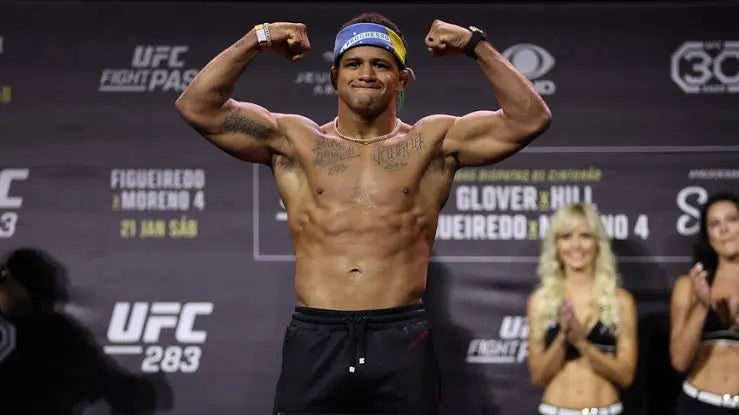
The device has been adopted by accomplished combat-sports athletes and coaches, including Gilbert Burns, Michael Chandler, Dan Moret, J’den Cox, Neil Melanson, Bryan Barberena, Dante Leon, and Jordan Johnson. Their backgrounds span Brazilian jiu-jitsu, wrestling, MMA, and submission grappling, but they all depend on the same fundamental physical quality: the ability to establish a strong grip and maintain it under pressure.
Gripedo’s own athlete archive also features world-class grapplers and fighters such as Mason Fowler, Dante Leon, Gilbert Burns, Michael Chandler, J’den Cox, and Rafael dos Anjos, demonstrating the device’s growing presence across multiple combat-sports disciplines.
Why Grip Strength Matters in Jiu-Jitsu
In jiu-jitsu, the hands are often the first point of contact between two athletes. Nearly every offensive or defensive exchange requires the ability to grab, pull, frame, rotate, squeeze, or hold.
In gi competition, athletes rely on their grip to control sleeves, collars, lapels, belts, and pant legs. In no-gi grappling, strong hands and forearms remain essential for wrist control, underhooks, clinches, takedowns, body locks, and submissions.
Grip strength can help an athlete establish control, but grip endurance determines how long that control lasts. A grappler may begin a match with powerful hands, only to lose effectiveness once the forearms become fatigued. Gripedo training is designed to develop both qualities, helping athletes produce force while also maintaining it throughout longer rounds and repeated exchanges.
Training More Than a Squeezing Motion
Many traditional grip trainers focus almost entirely on opening and closing the hand. Although squeezing strength is valuable, jiu-jitsu demands far more movement.
During a match, the wrists and forearms must rotate, stabilize, resist movement, and produce force from awkward positions. Gripedo can be used to train wrist flexion and extension, pronation and supination, static holds, rolling movements, pulling exercises, and rotational strength.
This allows grapplers to condition the hands and arms through a broader range of movements that more closely reflect the demands of live training.
Granular Training for Grip Endurance
One of Gripedo’s most recognizable applications involves placing it in a bucket of sand and twisting it against the resistance.
The sand creates constantly changing resistance that challenges the hands, wrists, forearms, and arm musculature as a whole. Because this form of training is primarily concentric, it can provide a lower-impact conditioning option that may be incorporated into warm-ups, accessory sessions, active recovery, or dedicated grip workouts.
Gilbert Burns has publicly demonstrated this method, describing Gripedo and sand as a demanding combination for developing grip strength. Dante Leon has also praised the device as an intense forearm and hand finisher and highlighted the importance of grip strength for grapplers.
Athletes can adjust the challenge by changing the depth of the Gripedo in the sand, the speed of the movement, the direction of rotation, or the duration of the set. This makes granular training useful for both strength and endurance development.
Stronger Wrist Control
Wrist control is a major part of jiu-jitsu. An athlete who controls an opponent’s wrist can limit posting, disrupt balance, open pathways to takedowns, and create opportunities for submissions.
Gripedo can be mounted on an Olympic-size barbell and used for wrist rolls, static holds, straight-arm turns, pronation, and supination. These variations strengthen the muscles responsible for rotating and stabilizing the wrist, rather than training the forearms through only one repetitive movement.
Stronger wrists may also help athletes resist grip breaks and maintain better alignment when pulling, framing, or controlling an opponent.
Better Pulling Strength and Upper-Body Connection
A grappler’s grip does not work in isolation. The hands connect the forearms to the arms, shoulders, back, and trunk. If the grip fails, the force generated by the rest of the body cannot be transferred effectively to the opponent.
Using its attachment pin, Gripedo can be connected to loading pins, kettlebells, cable machines, sleds, and pull-up bars. This allows athletes to add a demanding grip component to rows, carries, pull-ups, sled pulls, loaded holds, and other upper-body exercises.
These movements train the grip and upper body together, helping athletes strengthen the full pulling chain used during takedowns, guard passing, clinch control, and positional grappling.
Developing Strength That Lasts
Jiu-jitsu matches often involve extended periods of isometric tension. Athletes may need to hold a grip, maintain a body lock, control a wrist, or prevent an opponent from escaping for long periods.
Static holds and high-repetition Gripedo exercises can help condition the hands and forearms to continue producing force under fatigue. Athletes can also use circuits, supersets, drop sets, and timed rounds to recreate the accumulating fatigue experienced during grappling.
This form of training can be especially useful late in a match, when technical opportunities are often lost because the hands and forearms no longer have the endurance to capitalize on them.
Useful for Gi and No-Gi Athletes
Gi and no-gi athletes use their grips differently, but both can benefit from focused hand and forearm training.
Gi athletes frequently rely on sustained pinching and supporting strength while controlling fabric. No-gi athletes depend more heavily on wrist control, squeezing strength, rotational strength, and the ability to maintain hooks and clinches on a moving opponent.
Gripedo offers enough training variety to address these different demands. Athletes can emphasize static holds and fingertip control for gi gripping or use rotational exercises, pulling movements, and loaded carries to support no-gi performance.
Why Grapplers Are Adding Gripedo to Their Training
The Gripedo’s increasing adoption within the jiu-jitsu community comes down to three key qualities: versatility, durability, and sport-specific value.
One compact device can be used for sand training, wrist rolling, static holds, rotational work, carries, pulling exercises, and upper-body conditioning. This gives athletes and coaches the ability to target several aspects of grip performance without filling the gym with multiple single-purpose tools.
Athletes such as Gilbert Burns and Dante Leon have specifically highlighted its value for grip and forearm conditioning, while wrestling champion J’den Cox has described it as a tool he planned to keep in his training routine.
A Stronger Connection to Every Technique
Technique will always be the foundation of jiu-jitsu, but strength and conditioning help athletes apply that technique against skilled, resisting opponents.
Gripedo does not replace mat time. It helps support it by strengthening the physical connection between the athlete and the opponent. Stronger hands, more stable wrists, better pulling strength, and greater forearm endurance can help grapplers establish control and maintain it when fatigue begins to set in.
As more jiu-jitsu athletes, wrestlers, fighters, and coaches incorporate Gripedo into their programs, the device is becoming a trusted option for developing one of the most important—and most easily overlooked—areas of combat-sports performance.

Leave a comment
This site is protected by hCaptcha and the hCaptcha Privacy Policy and Terms of Service apply.